


Introduction
A car engine produces power, but that power must be controlled and transferred to the wheels to move the vehicle efficiently. The system responsible for managing this power is called the transmission system. Without a transmission, a car would not be able to operate smoothly at different speeds.
The transmission allows a vehicle to accelerate from a stop, maintain speed on highways, and climb hills without overworking the engine. It adjusts the amount of power sent to the wheels depending on driving conditions.
Understanding how a transmission system works helps drivers better understand their vehicles and maintain them properly. This article explains the purpose of a car transmission, the major components involved, and the differences between manual and automatic transmissions.
What Is a Transmission System?
The transmission system is a mechanical device that transfers power from the engine to the wheels. It controls how much power reaches the wheels and adjusts the engine speed according to driving conditions.
The engine produces rotational energy, but it cannot efficiently power the wheels at all speeds by itself. The transmission solves this problem by using gears to regulate speed and torque.
Torque is the force that turns the wheels, while speed determines how fast the vehicle moves. The transmission balances these two factors to ensure smooth driving.
Why a Transmission Is Necessary
Vehicles require different amounts of power depending on their speed and driving conditions.
For example:
- Starting from a stop requires high torque.
- Driving at high speed requires less torque but higher wheel rotation speed.
- Climbing hills requires more engine power.
The transmission allows the engine to operate efficiently while adjusting the power delivered to the wheels.
Without a transmission system, the engine would either stall or operate inefficiently.
Main Components of the Transmission System


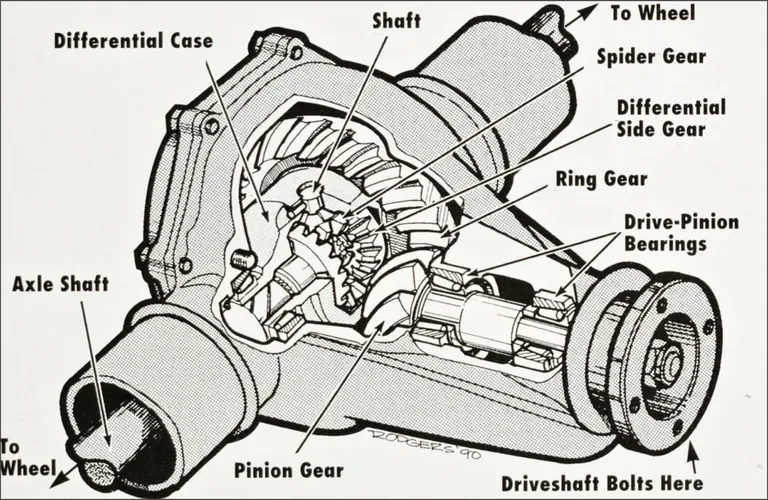
Several important components work together in the transmission system.
Clutch
The clutch connects and disconnects the engine from the transmission.
When the driver presses the clutch pedal in a manual car, the engine temporarily disconnects from the wheels. This allows the driver to change gears smoothly.
Once the gear is selected, releasing the clutch reconnects the engine to the transmission.
Automatic cars do not use a traditional clutch because they use a torque converter instead.
Gearbox
The gearbox contains several gears of different sizes.
These gears change the ratio between engine speed and wheel speed.
Lower gears provide more torque for starting and climbing hills, while higher gears allow the vehicle to travel faster with less engine effort.
Driveshaft
The driveshaft transfers rotational power from the transmission to the differential.
It acts as a connector between the gearbox and the wheels.
In front-wheel-drive vehicles, the driveshaft is shorter because the transmission is located near the front wheels.
Differential
The differential distributes power from the driveshaft to the wheels.
It also allows the wheels to rotate at different speeds when the car turns.
This feature is important because the outer wheel travels a longer distance during turns than the inner wheel.
Gear Ratios and Their Importance
Gear ratios determine how engine power is transferred to the wheels.
Different gears have different ratios that control torque and speed.
Low Gears
Low gears provide more torque and less speed.
They are used for:
- Starting the vehicle
- Climbing hills
- Carrying heavy loads
High Gears
High gears provide less torque but allow higher speeds.
They are used when the vehicle is traveling at a steady speed on highways.
Higher gears also improve fuel efficiency.
Types of Car Transmission
Cars use different types of transmission systems depending on the vehicle design.
Manual Transmission
Manual transmission requires the driver to change gears manually using the gear lever and clutch pedal.
In this system:
- The driver presses the clutch pedal.
- The driver moves the gear lever to select a gear.
- The clutch is released to reconnect the engine.
Advantages of manual transmission include:
- Better fuel efficiency
- More control over the vehicle
- Lower maintenance cost
However, manual transmissions require more driver skill.
Automatic Transmission
Automatic transmission changes gears automatically without the driver’s input.
The system uses hydraulic pressure, sensors, and electronic controls to determine the correct gear.
Automatic cars are easier to drive because the driver only needs to operate the accelerator and brake pedals.
Common gear positions in automatic cars include:
- P (Park)
- R (Reverse)
- N (Neutral)
- D (Drive)
Automatic transmissions provide smooth and convenient driving.
Continuously Variable Transmission (CVT)
CVT is a modern type of automatic transmission that does not use traditional gears.
Instead, it uses pulleys and belts to provide a continuous range of gear ratios.
Advantages of CVT include:
- Smooth acceleration
- Improved fuel efficiency
- Reduced engine strain
Many modern vehicles use CVT technology.
How Power Flows Through the Transmission
The process of transferring power from the engine to the wheels involves several steps.
- The engine generates rotational power.
- The clutch or torque converter connects the engine to the transmission.
- The gearbox adjusts the power through gear ratios.
- The driveshaft transfers power to the differential.
- The differential distributes power to the wheels.
This system ensures that the vehicle moves smoothly under different driving conditions.
Transmission Fluid and Lubrication
Transmission components operate under high pressure and friction.
Transmission fluid lubricates the gears and prevents overheating.
It also helps maintain hydraulic pressure in automatic transmissions.
Regularly checking and replacing transmission fluid is essential for maintaining the transmission system.
Common Transmission Problems
Transmission systems may develop problems over time.
Common issues include:
- Difficulty shifting gears
- Slipping gears
- Unusual noises from the gearbox
- Transmission fluid leaks
- Delayed acceleration
These problems often indicate worn components or insufficient lubrication.
Prompt inspection and repair can prevent serious damage.
Importance of Transmission Maintenance
Proper maintenance helps extend the life of the transmission system.
Recommended maintenance practices include:
- Checking transmission fluid regularly
- Replacing worn clutch components
- Inspecting gear systems
- Avoiding aggressive driving habits
Good driving habits also reduce stress on transmission components.
Advantages of a Well-Functioning Transmission
A properly working transmission system provides several benefits.
These include:
- Smooth acceleration
- Improved fuel efficiency
- Better engine performance
- Reduced mechanical wear
A reliable transmission also improves overall driving comfort.
Conclusion
The transmission system is a vital component of any vehicle. It transfers power from the engine to the wheels and ensures the vehicle operates efficiently at different speeds. By adjusting gear ratios, the transmission allows the engine to perform optimally under various driving conditions.
Components such as the clutch, gearbox, driveshaft, and differential work together to deliver power smoothly. Different types of transmissions, including manual, automatic, and CVT systems, provide different driving experiences and advantages.
Understanding how the transmission system works helps drivers appreciate the engineering behind their vehicles and encourages proper maintenance. With regular care and responsible driving, a transmission system can operate reliably for many years.